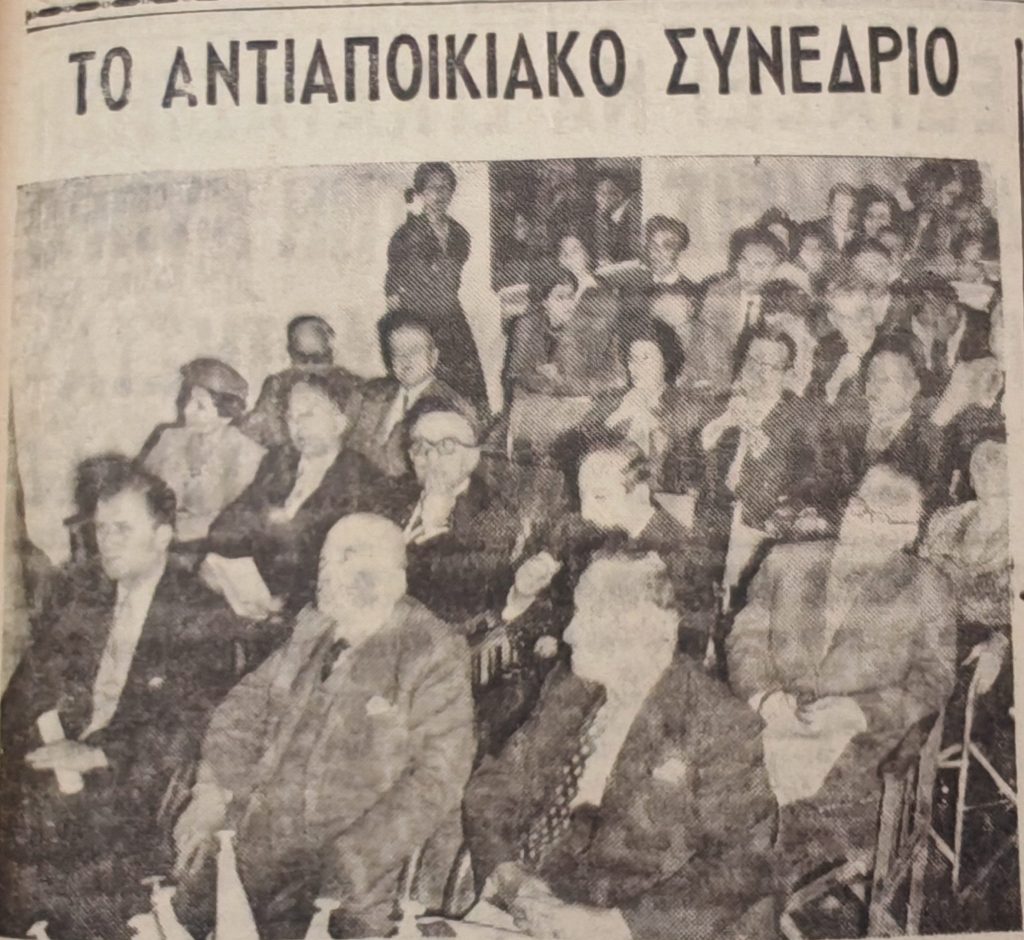
A cutting from the newspaper Avgi from 3 November 1957.
The headline reads “The Anticolonial Conference”.
Way up town in the northern suburbs, a group of delegates representing Greece, Syria, Lebanon, Jordan, Iraq, Kurdistan, Egypt, Algeria, Tunisia, and Morocco – as well as Italy, France, Yugoslavia, and England – are gathered for the “Anticolonial Conference of the Mediterranean and the Middle East”. It’s November 1957. The European delegates arrive by train; the Arabs by boat. The Greek leftist press reports the event in a mid-century tenor, announcing it as a gathering of “personalities from the anticolonial movements”.[i] The conference agenda is focused on four main themes, amongst other discussions: Algeria, Cyprus, the “free economic and social development of the people of the Middle East”, and “general suggestions for the international anticolonial movement”.[ii] It’s reported in the press that the Greek government is not friendly towards the conference.[iii] The CIA is keeping an eye on it.
Organised by the Greek Anticolonial League, and running for four days at the start of the month, the conference made anticolonialism again a Mediterranean question. The event fits into, and in some ways complicates, anticolonial geographies that had been coalescing since the start of the 20th century and gathering pace in its middle decades. This history is one of transcontinental movements and imaginations, centring on Afro-Asian solidarities and, slightly later, the development of Tricontinentalism, adding the Americas to these interconnected struggles.[iv] These mid-century movements were at once focused on the very real work of liberation and independence from empires, and simultaneously on the development of cultures of resistance that could disorder the global colonial order – what Anna Agathangelou calls “a dream of South-South connections with alternative forms of modernity, industrialization and social expressions”.[v] Or what Chandni Desai and Rafeef Ziadah call “insurgent geographies of connection”, wherein struggles relate and respond to each on their own terms, making their own sense of space and future.[vi] The task was nothing less than that of unmaking imperial geographies and histories, and making another world in its place.
By bringing these energies into an Anticolonial Conference of the Mediterranean and the Middle East, the organisers and delegates sought to expand these histories and geographies further. Southern Europe becomes the Northern Mediterranean, and the event sought to loop solidarities around the sea and beyond.[viii] At the first of two preparatory gatherings, also held in Athens in January of 1957, it was announced that “the purpose of the conference and the anticolonial movement in general is to condemn colonial work and to assist in solving the colonial problem”.[ix] In addition to members of the Greek Anticolonial League, this first pre-conference was attended by Joseph Murumbi, at the time the Secretary General of the World Council for the Freedom of the Colonies, as well as leaders of the Algerian liberation struggle and the Goan resistance movement, representatives of the Committee for Justice and Freedom of the French Colonies and the Arab League, and representatives from Italy, Egypt, Lebanon and Yugoslavia.[x]
Discussions were clear-sighted. Addressing an audience including the mayors of Athens and Piraeus, Greek leftist parliamentarians and the Athenian press, Murumbi spoke of the inspiration provided by the struggles of the people of Kenya for their self-determination, and emphasised the need to unite the efforts of all free peoples for the liberation of the colonies.[xi] He emphasised that no weapons could force people seeking self-determination into submission, gesturing towards Cyprus specifically, because “the spirit of the people is what determines their right to self-determination and no power on earth can kill it”.[xii] The representative of the Committee for Justice and the Liberation of the French Colonies followed by stating that France must find a solution to the Algerian problem, highlighting that the French government’s obsession with the colonial fight against the Algerian people “not only wears out France’s forces, but also breeds abnormal and undemocratic behaviour within the metropolis itself”.[xiii] The representative of the Algerian National Liberation Front responded by stating that the anticolonial conference would be “an important step in the struggle of the colonised peoples”, in that it would strengthen movements in different places, and “contribute to making known the struggle of colonised peoples”.[xiv]
At a second preparatory meeting in April, the name of the conference was settled, with delegates agreeing that the gathering would centre its conversations in the anticolonial struggles of the Mediterranean and the Middle East, and that Athens provided the “most suitable ground” for these discussions to take place.[xv] The scope of the event was drawn up, and delegates at a lunch hosted by the Greek Socialist League emphasised that the conference could not unfold without also supporting the thousands of political prisoners and exiles in Greece, banished to prison islands during the Civil War for fighting in, or even sympathising with, the Greek People’s Liberation Army (ELAS) – thereby extending practices of earlier regimes in Greece who had used barren islands as carceral spaces for political opponents and dissidents, communists, leftists, and trade unionists. “Because freedom,” the delegates concluded, “is one and indivisible”.[xvii]
The main conference in the autumn was front page news. Opening with a reception at the Pnyx – the ancient Athenian gathering place for public assemblies – and a demonstration down the coast at the Temple of Sounion, the conference commenced in an “atmosphere of intense anticolonial spirit”.[xviii] Nicos Pouliopoulos, President of the Greek Anticolonial League, spoke first, emphasising “the need for an intense struggle for the freedom and independence of all peoples and against subjugation of any form”.[xix] Fenner Brockway, British Labour Party MP and President of the Movement for Colonial Freedom, stressed that the “Great Powers” should leave the countries of the Middle East undisturbed, “so that they can live peacefully among themselves”.[xx] The Cypriot delegate thanked the Arab delegations for their support for self-determination, highlighting common struggles between them. Salah Abdel Hafez of Egypt paid tribute to the martyrs of the independence movements who had fallen in Cyprus, Algeria, Oman, and Palestine.
Conversations intensified. The Tunisian representative, Mr Mahmoud, focused the conference’s attention on the fact that colonialism – even in places that had already achieved independence – was undying. Although Tunisia had thrown off the French the previous year, Mahmoud asserted that Tunisia would not remain quiet as long as their Algerian neighbours, as well as all other countries under colonial rule, remained unfree. He called upon all “people of good will to join forces to combat colonisation”.[xxi] The Italian representative promised the full support of the Italian people in the fight. Students of the University of Athens sent greetings to the conference and solidarity against all forms of empire. Telegrams from the Algerian delegation addressed to the Greek people, and from the political prisoners exiled on the Greek island of Agios Efstratios, were printed in the Greek press. A feedback loop of circulating struggles was spun into existence from all directions.
The Algerian delegation of the National Liberation Front, which has the honour of leading the national liberation of the Algerian people, today, Wednesday, the anniversary of the Algerian war of liberation, sends fraternal greetings to the Greek people.
The Algerian people, who have been fighting for years for their freedom and independence, see the Greek people as a friend and ally. The two peoples are fighting for the same goal, for the same ideal.
Last year, Greece’s representative to the UN supported the Algerian case with their vote. There is no doubt that at this year’s session, the representative of the Greek people – who deeply appreciate the freedom of peoples and their right to self-determination because they suffered greatly during the foreign occupation [of the Second World War] – will once again side with justice.
The Algerian delegation taking part in the Anticolonial Conference expresses its thanks to the members of the Anticolonial League for inviting the representatives of the Algerian struggle and congratulates them for their courage and sacrifice in organising the conference in Athens.
We are confident that this conference will lead to decisions that will help Algeria regain its freedom and independence.[xxii]
Distinguished gentlemen [sic],
With particular satisfaction, 440 political exiles from the desert of Agios Efstratios, who have been held under the most inhumane conditions for twelve whole years as hostages of the government, send you our warm and combative greetings.
Your conference is meeting at a time when humanity proudly rejoices in the triumph of science and its peaceful conquests, but also at a time when it is in danger of sinking into immense catastrophes, with the implementation of the “Eisenhower Doctrine” and other aggressive plans for the predatory interests of the colonialists of Washington and London.
We hope that your conference will contribute decisively to the implementation of the principle of self-determination for our martyred and bloodstained Cyprus, so that our enslaved brothers and sisters may be freed from the shackles of colonialism.
We also hope that it will contribute decisively to our country finding its national independence. To thwart the imperialists’ plans. To preserve and secure the long-desired peace in the region and throughout the world.
Finally, we hope that you will not fail, alongside your other struggles, to fight to save from bondage the victims of imperialism and the policy of national subjugation in our country – that even before the end of World War Two was among the first to receive the barbaric blow of the cruel British colonialists. That you will not stop demanding from the government that the inhumane deportation and the fascist concentration camps be abolished and that a general political amnesty be granted, which the Greek people so desire and demand, for their peace, happiness, and prosperity.
Your classmates in your sacred but hard struggle, we wish you complete success in the work of your conference.[xxiii]
People did the work of placing their struggles into relation. Greek political prisoners demanding the abolition of detention camps circles into the Algerian liberation movement, into calls for independence and self-determination in all places around the sea and beyond it, into resistance against colonialities old and new, into a joined-up sense of ever-circulating struggle. The conference’s “atmosphere of intense anticolonial spirit” reported in the Greek press speaks directly to what’s often called the “spirit of Bandung” – those anticolonial imaginations that coalesced at the Bandung Conference of Afro-Asian solidarity two-and-a-half years earlier, itself a regathering of intimacies that extend much further back.[xxiv] At the end of the Mediterranean conference, delegates unanimously agreed on the inviolable right of self-determination for all peoples and that colonial powers should “cease to covet” the region. The conference condemned “any form of military intervention that aims to serve the economic, political or strategic interests of certain powers at the expense of the national sovereignty of other countries”, and equally condemned the Eisenhower Doctrine and the Baghdad Pact – both treaties drawn up to bolster U.S. interests in the Middle East. The rights of Palestinian refugees were emphasised. Delegates decided to set up a Committee for the Struggle Against Colonialism in the Mediterranean and Middle East Region to continue all this work.[xxv]
The following day, after the conference had concluded, there was a reception at the Syrian embassy in Athens. Conference delegates and members of the Greek Anticolonial League were present, along with the mayors of Athens and Piraeus again, as well as Greek politicians and ambassadors of countries from around the Mediterranean and from Eastern Europe. There were speeches wishing for the success of the goals of the conference and for the destruction of colonialism. Attendees toasted the ties that connect Greece and Syria. The press reported that “nothing is capable of breaking the bonds between the peoples of these two countries”.[xxvi]
[i] Avgi, 2 November 1957. All translations from Greek in the section are the author’s.
[ii] Avgi, 31 October 1957.
[iii] Avgi, 31 October 1957.
[iv] See e.g. Garland Mahler, From the Tricontinental to the Global South.
[v] Agathangelou, “Throwing Away the ‘Heavenly Rule Book’”, 102. The idea of disordering the colonial order is from Fanon, The Wretched of the Earth. On creative solidarity and resistance cultures, see Gaztambide-Fernández, “Decolonization and the pedagogy of solidarity”; Kanafani, “Study from Palestine”; Desai and Ziadah, “Lotus and its Afterlives”.
[vi] Desai and Ziadah, “Lotus and its Afterlives”, 291. This is close to what Pham and Shilliam write of as people “defying colonial cartographies that outlawed the colonised from relating to one another on their own terms”. “Reviving Bandung”, 9.
[viii] Kornetis “Cuban Europe?”; Stefanidis, Stirring the Greek Nation.
[ix] Avgi, 18 January 1957.
[x] Avgi, 18 January 1957.
[xi] Avgi, 22 January 1957.
[xii] Avgi, 22 January 1957.
[xiii] Avgi, 22 January 1957.
[xiv] Avgi, 22 January 1957.
[xv] Avgi, 26 April 1957.
[xvii] Avgi, 26 April 1957.
[xviii] Avgi, 3 November 1957.
[xix] Avgi, 3 November 1957.
[xx] Avgi, 3 November 1957.
[xxi] Avgi, 3 November 1957.
[xxii] Avgi, 2 November 1957.
[xxiii] Avgi, 6 November 1957.
[xxiv] Plenty has been written about Bandung, but these particular themes have been well explored by Pham and Shilliam and the authors in their edited volume Meanings of Bandung.
[xxv] Avgi, 6 November 1957. Kornetis, “Cuban Europe?”, 491.
[xxvi] Avgi, 7 November 1957.
 Undercartographies
Leave a comment